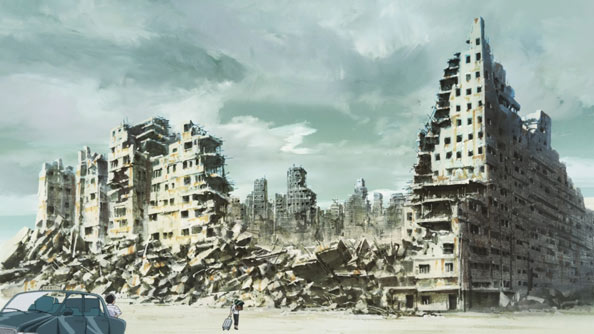
12 Days of Anime 2025, Day 8Nostalgia is one hell of a drug, and Kowloon Generic Romance runs with this idea on the visual, thematic, and literal level. Its shining thing is the Kowloon Walled City, a single city block in Hong Kong built up to impossibly dense levels during the second half of the twentieth century. You only get these unzoned skyscraper settlements where a) the political status of the area is contested, b) there are borders or physical barriers preventing sprawl, and c) the space is undesirable enough to escape redevelopment or bombs. From the back-to-back colonial occupations to the Chinese Civil War, the geopolitical conditions that led to the creation and eventual destruction of the Kowloon Walled City are one of a kind. There will never be another.…okay but what if there was??? Kowloon Generic Romance knows exactly what it wants: hot muggy summers, grimy streets, alleyways that never see the sun, densely packed interiors, hawkers with every counterfeit product under the sun, and a gruff, tight-knit atmosphere. But this idealized Kowloon is getting chipped away at from the outside: residents now have phones, trendy instagrammable restaurants are constantly popping up, and long-time residents seem to keep disappearing. Not to mention the giant sci-fi device quietly floating above the town. There is mystery afoot in this small yet towering world. And in the same way an empty field makes the Miyazaweans dream of yuri, doesn’t the thought of an anarchic urban enclave where every building is over ten stories tall inevitably have you imagining a beautiful woman with short black hair and glasses smoking on her balcony in there?It certainly does for the author of this manga. Kowloon Generic Romance slots firmly into the “cozy hell” aesthetic milieu present in VA-11 Hall-A and really any sufficiently slice-of-life dystopian work. Slow pacing is important for these kinds of stories - it gives the reader time to bask in the vibes, let beauty emerge out of the grit, and get a feel for how normal people go about their lives in an objectively rough but aesthetically pleasing setting. In fact, it takes a whole volume before the central mystery of the story is even hinted at – that protagonist Reiko is a clone of a deceased woman, Kuji-B and she’s been swapped into her former life with no explanation or long-held memories.It turns out that most of the cast is haunted by matters of identity, and that that’s one of the prerequisites for even being able to interface with this version of Kowloon. Most of it is pretty gendery, too. Reiko’s past life had a femme fatale air about her that she finds herself unable to replicate, and her mans Kudo, the former lover of Kuji-B, is distraught when she tries to replicate it. Her best friend, Yaomay, is a former child actor whose mother was grooming her into her own mini-me. She cut all ties, ran away to Kowloon, and got so enough cosmetic surgery that nobody would be able to recognize her from her past. Techno-pharma CEO Miyuki has that classic Mysterious Anime Intersex thing going on, which adds an extra layer of familial resentment to his schemes on top of further queering his yaoi moments. And then Xiaohei actively has a gender nightmare going on. He’s so tortured about growing up and no longer being able to convincingly crossdress that he literally manifests as a cis woman in Kowloon out of a mixture of desire and nostalgia-turned-regret. It’s like that sometimes.You could probably hazard a guess as to what’s going here on if you were reading between the lines, so to spoil it all outright, this version of Kowloon is a simulation that aims to replicate how city was before it was demolished three years prior. It’s populated entirely by clones and people with strong enough wants and connections to the original city that they can actually partake in the simulation, which ends up eating away at their memories of the outside world. The tech powering it was developed by Miyuki after he inherited his abusive adoptive father’s company. He aimed to use it to torture his old man with endless bad memories, but the project took so long that said old man developed dementia, rendering it all useless. The actual emotional core of the simulation ended up being Kudo, wracked with grief over his fiancé Kuji-B killing herself, wishing he could turn back time and share an endless summer in Kowloon with her. It’s a messy but fun mix of sci-fi and romance, built around the literal and metaphorical weaponization of nostalgia. While it still could whiff the landing, I had a good time with this manga, even if it’s not the easiest recommendation.But the anime…. the struggle of getting this stuff onto the screen! Kowloon Generic Romance received a thirteen-episode adaptation earlier this year, animated by no-name studio Arvo Animation clearly biting off more than they could chew. Not only was the project daunting from a plotting and aesthetic standpoint, but with Bandai Namco on the production committee, they were almost certainly dealing with heavy-handed oversight and brutal deadlines.As both a cost-saving method and a necessary wellspring of nostalgia, Arvo frequently tries to invoke old-school anime aesthetics, and it only works sporadically. The character art is pretty good, but there’s a consistent struggle to move these characters that frequently kills the vibe. The backgrounds on the other hand, are fucking amazing! They were done by renowned art studio Aoshashin, who are frequent contributors to Studio Orange productions and more recently worked on Look Back. They contributed all their art in advance, avoiding the production crunch entirely. So it’s jarring to see the animators struggle to properly light their characters against their surroundings, with animation way too choppy for the disparate elements to mesh. The production lurches from episode to episode, where some pretty much have it together and achieve the artfulness I’d want out of this adaptation, and some absolutely do not. In one episode, the character art falls back on 2000s-level line thickness and detail. This whole thing smacks of some truly nasty crunch, and even if the studio had been given the proper amount of time and resources, there still would have been the hard problem of the episode count.Remember how I said earlier how vibes-based works live or die on their pacing? The anime version of Kowloon Generic Romance adapts eleven manga volumes into a single cour. The normal conversion rate for anime is three or four episodes per tankobon, so needless to say this is absolutely breakneck. Not only that, but they had to come up with an anime-exclusive ending, since the manga is nearing its conclusion but isn’t quite there yet.Given those parameters, the only way to achieve a complete adaptation is to cut out the slice of life aspects and turn the story into more of a thriller. It works… sometimes. The biggest problem is that the central romance is much harder to care about when we hardly ever get to see the characters interact organically. It also means that the story’s jargon and plot bullshit both accumulate at a much faster pace, making it a more confusing watch than it needs to be. In some ways it’s a respectable move to try and get to the perceived “meat” of the work and tell a story with a start and a finish rather than leave on a cliffhanger if you know you’re not likely to get a second season. It’s just that a shame it came at the cost of what I liked out of the original. As most are, the anime-exclusive ending is half-baked. Reiko finds a way to become a Real Girl, and her and Kudo get together for good instead of moving on with their lives. It clashes with the rest of the show’s themes around desire and letting go and living your absolute self, and makes the whole thing suddenly smack of Final Fantasy X ( / X-2 HD Remaster) at the last minute.I actually got to attend a Bandai Namco industry panel focused on Kowloon Generic Romance earlier this year at an anime convention – it was very enlightening in ways that were surely unintentional. While much of it was just PR for an anime that had already ended and was clearly not the breakout hit that they wanted it to be, they had producer Ryouya Arisawa headlining the event, and I was surprised by just how young he looked. When asked about his experience working on the show, he responded that he was stressed about getting the episodes done on time, and was relieved that it was over now. In studio speak, I’m pretty sure that means that many long nights were had on an absolutely grueling production. He then made a remark about how after wrapping up work on the anime, he immediately had to pivot to producing the movie!That’s right, Kowloon Generic Romance also received a film adaptation earlier this year, and they apparently press-ganged this poor man into working on them back-to-back. I can only hope he got some rest on the international flight to the con. As far as I can tell, the KGR movie never got a release outside of Japan, and that it was pretty terrible. The anime already had to rush to try and hit all of the major plot beats, so I can only imagine how impossible of a task it was to get everything across in under two hours, all while being hampered by the usual challenges of translating manga aesthetics into live-action. ??????????So that leaves us with one “okay but failed to live up to its potential” and one “why would you even try this” between these dual adaptations. In conclusion, it’s kind of awesome to have an endless stream of opportunities to write about some new way that Bandai dropped the ball. See you all next year for Hathaway 2!
Dec 21, 2025 • Subscribe
KOWLOON GENERIC ROMANCE, LOOK BACK, Real Girl, Legend of the Crystals: Final Fantasy
More like this
Kowloon Generic Romance – 05 – Living is Wanting More
Hajime turns his admission of killing Kujirai B into a “what if,” stating he was only joking. Yaomei, who has always been hostile towards Hajime, is certain Hajime…

Review: I Like You More (2023)
I Like You More 倍儿喜欢你 China, 2023, colour, 2.35:1, 98 mins. Director: Guo Dalei 郭大雷. Rating: 5/10. Odd-couple rom-com has strong leads and starts well, but the bumpy…

Shonen Jump? More Like Shojo Jump!
Shonen Jump is changing and it's for the better. We've got Blue Box, Akane Banashi, Ruri Dragon and Witch Watch leading us into a whole new era…
Kowloon Generic Romance
This is not going to help me remember the name of Repo the Genetic Opera... 4:08 - Kowloon Generic Romance 44:55 - Undead Unluck 231 58:18 - Blue Box 173 1:10:09 /…
Kowloon Generic Romance
Plot: With its flickering streetlights, moldy back alleys, and noisy populace, the Second Kowloon Walled City, despite the squalor of its already-demolished predecessor, evokes a special kind of…

Seasonal First Impressions: This City Knows Your Name – Remembering and Forgetting in KOWLOON GENERIC ROMANCE
A drifting mix of signifiers meant to rouse our interest without answering too many questions upfront. Kowloon certainly, Romance, more or less. Generic, I’m not so sure.

Kowloon Generic Romance – 05
Let's talk about goldfish.

Kowloon Generic Romance – 03
A sense of nostalgia for a place I've never been, indeed.

Kowloon Generic Romance – 02
What does all this add up to? It's hard to say.

Kowloon Generic Romance – 04
With apologies to disappointed manga readers (of whose number I have often been one), this is still great.

Kowloon Generic Romance Episode 4 Review – Kowloon And Clone Sound Similar
Raise your hand if you’re not a clone!
More Like “Protoculture Festival”: Hashikko Ensemble, Chapter 31
After months of focusing on the same song, the musical possibilities explode. Summary Still at their summer training camp (of sorts), the Chorus Appreciation Society decides that they…
How RahXephon is more like Gundam than Eva
One of the temptations I’ve faced as I’ve been watching RahXephon is to compare it to Neon Genesis Evangelion. There are two reasons for that. The first is…


More like Gundam oh oh Oh Oh! OHHHH!
This week: Saji “docks” his “riser” on Setsuna from behind. Setsuna’s balls drop (pictured).


Berserk of gluttony; gluttony of mid more like
Berserk of gluttony is more or less what it turned out to be


First Impressions – Kowloon Generic Romance
There are a couple of reasons to be cautious but boy, one couldn't ask for a much better premiere than that.

First Look: Kowloon Generic Romance
Reiko Kujirai lives within the Kowloon Walled City, working as a real estate agent and nursing her crush on her co-worker, Hajime. Life goes on as usual, until…

Kowloon Generic Romance – Episode 1
this is a rich premiere that bubbles with a mix of affection and suspicion for that thorny concept of “nostalgia.”

Kowloon Generic Romance Ep 4
There was a big theme going on about the values and purposes of ‘fake copies” this episode!

Kowloon Generic Romance v. 1
A review of the first volume & first impressions

First Impression: Kowloon Generic Romance
Kujirai is a pretty efficient office worker, keen to do a good job, but you probably couldn’t tell that from her morning routine, which is more in keeping…

The ANN Aftershow - More Like "Hash the Stampede," Amirite?
We're diving right into Vash and Knive's backstory this week! Also this week in Buddy Daddies, Rei has to choose between allegiance to his birth family and his…

Talking To Strangers? More Like Theorizing About Strangers (DNF)
There is no talking to strangers in this book, but more theorizing about strangers.

(#ShonenJumpMovieNight) City Hunter: Bay City Wars
So yeah, it’s time for the second shot at City Hunter. This time, well it feels like a conventional sort of action movie, 45 minutes long. But one…
I think I'd like Demon Slayer more if I had more interest in shounen jive
Thankfully, Zenitsu's internal voice is much less annoying than his outward character.

Wicked City
(**Warning – This review is a tad more not safe for work then my average review. You have been warned**) Wicked City is a 1987 Madhouse film directed by one…


Kowloon Generic Romance Ep 2 & 3
W-W-WHAT THE HELL WAS THAT!?

PODCAST: Ep. 79: Kowloon Generic Romance
"After The Rain's" Jun Mayuzuki returns with a new sci-fi tinged romantic comedy that's anything but generic...
Kowloon Generic Romance #01 — Pulsating Rhomboid
Not sure I was expecting all the bubblegum pop. Impressions: I don't know why, but I chuckled every time they cut to the pulsating rhomboid hovering over…

Kowloon Generic Romance – 04 – Absolute Self
A common tactic with any mystery box show is to provide enough of a trickle of answers to keep the audience engaged, while at the same time raising…


Saki Zenkoku-hen Episode 2: Now That’s More Like It.
… Except it’s not really. While episode 2 is a vast improvement from the horrors of episode 1, the anime is still stuck with its character introductions, both…


I wanted to like this more – Girls Gaku drama review
Seemingly a lifetime ago (i.e. July) I wrote up my first impression of this drama. Given it’s outside my usual bubble of drama-watching habits, I wasn’t sure how…

Which anime would you like to see get more accolades?
Are industry awards important to you? Do awards or honors make you more likely to check a series out? What award would you invent to give your fave? The…
Summer In The City – City Hunter TV 1
I’m an absolute mark for 80s and 90s action cinema. Representative as some of them may be of an overbearing masculinity that sought to quell the voices…


Onsen City in Japan That Gets 85x More Tourists Than Residents Institutes New Rules
A popular onsen in Yamagata Prefecture brings in so much traffic that the city has instituted new rules to reduce congestion.
I Want More Anime like O Maidens in Your Savage Season!
2019 has seen no shortage of amazing anime. There’s been an abundance of big-money sequels, like Mob Psycho Season 2, Attack on Titan Season 3, and My Hero…

More Asinine Cheat Power Stupidity #01 — “Just Like a Video Game!”
Please, say it again. I didn't catch that the first four times. Impressions: I would say that this crap is getting particularly lazy, but it's always been.…

Anime World Order Show # 240 – Jazz Music? More like JASS Music
In this episode, Gerald jazzes up the proceedings by reviewing the 2023 theatrical film Blue Giant, released in theaters, home video, and streaming by GKIDS. Introduction (0:00 –…

Anime Series Like More Than a Married Couple, but Not Lovers
Jirou Yakuin, third-year high school student and otaku, has had a crush on his childhood friend, Shiori. He hopes to be paired with her for their school's
Nisekoi, A Couple of Cuckoos, Engaged to the Unidentified, Golden Time, My First Girlfriend is a Gal
![Featured image for Kowloon Generic Romance Ep 1 [First Impression]](https://cdn.aniblogtracker.com/live/20250406/1743976557.100906.144176.png)
Kowloon Generic Romance Ep 1 [First Impression]
Man this is so trippy, I love it! The importance of quirks, the value of nostalgia, and the goldfish of forgetfulness!

Kowloon Generic Romance – 01 – The Right Prescription
Kowloon Generic Romance starts off pleasingly lo-fi, with its protagonist Kujirai Reiko waking up and starting the day with a breakfast of watermelon and cigarettes on her balcony,…

Manga of the Month: Kowloon Generic Romance
Kowloon Generic Romance by Jun Mayuzuki While the story of Kowloon Generic Romance does take place in Hong Kong’s Kowloon Walled City, it is anything but generic. Real…
Pick of the Week: Kowloon Generic Picks
ASH: There certainly are a fair number of releases this week! Debut-wise, I find that overall the novels have caught my attention the most, with Sword of the…

Kowloon Generic Romance – 03 – Field of Gazes
In another flashback from his POV, Hajime suddenly gets dizzy while on the job with “Kujirai A,” and she invites him to her place to rest and recover…
Episode 934: Kowloon no Orgel Pale Magic
This week on Anime Pulse we got groundhog day romances, snagging hot merchandise, and anti-heroes. Up first Andrew is back from his Chinese New Year celebrating, and Joseph…
Black Magic M-66, Kowarekake no Orgel, KOWLOON GENERIC ROMANCE, Pale Cocoon

The Mad City
「出会い系サイトで70人と実際に会ってその人に合いそうな本をすすめまくった1年間のこと」、花田菜々子 My Year of Meeting 70 People in Real Life via an Online Matching Site and Recommending the Perfect Book, by Nanako Hanada I read this book when…

The Mad City
「出会い系サイトで70人と実際に会ってその人に合いそうな本をすすめまくった1年間のこと」、花田菜々子 My Year of Meeting 70 People in Real Life via an Online Matching Site and Recommending the Perfect Book, by Nanako Hanada I read this book when…
Detroit Metal City
A manga about a wannabe pop singer who moonlights as the lead singer for the death metal band Detroit Metal City! Continue reading →

The Sinking City
1920s New England. A hardboiled private investigator from Boston travels to a small town off the coast of Massachusetts to investigate myste...
